I was searching online today about a book I remembered from University, James Agee and Walker Evans’ “Let Us Now Praise Famous Men” when I stumbled upon a link in a wikipedia article that took me to a follow up book that traced the families that Agee and Evans wrote about. When I clicked the link, it took me to [WorldCat.org] Search for books, music, videos, articles and more in libraries near you. Poof, not only did WorldCat tell me about the book, but it showed me all the libraries and book stores NEAR ME that had the book. I was reawakened to the ease of accessing my library (a 1 mile walk). Fantastic service!
Day: February 15, 2008
Making Sense of Communities and Networks
Via a twit from Jeremiah Owyang I was led to a post from Nick O’Neill, Do Social Networks Follow the Traditional Business Cycle – Covering All That’s Social All the Web critiquing a recent report by Jeremiah. Jeremiah asked what we thought of Nick’s critique, particularly of the image from Jeremiah’s Forrester report.

My response:
Since I can’t read the report, my response may be out of context. But I don’t think what the chart references is a community by my definition, which is a bounded set of people. (addition – actually, that’s only PART of my definition.) Communities don’t scale out and out.
Most commercial “communities” (which I assume Jeremiah is talking about) are actually networks and the people in them change over time. There may very likely be communities that form and persist over time as well, but their growth is never continually up. Then tend to find a stasis point which doesn’t change much.
The commercial networks right now may play out like this chart, but I think there is something specific and important that is not reflected in this chart and that is the challenge of multi-membership and the proliferation of network alternatives.
Right now, for example, social network sites are hot and have a huge growth. But we are starting to see the fatigue (too many widgets, to many alerts and messages with no granularity to their usefulness or aggregation in ways that makes sense to the individual, my friend just invited me to another network, my “friend” who I don’t really know started spamming me.)
No amount of ongoing management and continual improvements is going to be able to control the impact and draw/drain of the larger market of networks. It can fight against it, but the fact is people are fickle and will move on.
The differentiation will be those sub communities that form and persist. One strategy to explore is how to create the welcoming space for those communities, and expect the number of communities to grow, rather than the size of any one community.
Then you have not one single upward curve, but many that weave into a successful vortex that persists even though MANY people will come and go.
An example of this is the Share Your Story community at http://www.shareyourstory.org
I get a bit concerned about the hyping of community as well. This is more an intuitive than logical data-driven response, but the image above is more hype than reality as it stands on its own. I’d love to see it reframed from a network perspective which I think is both more scalable and sustainable.
Then I tweeted that I thought, out of context, the image was a bit of a hype. Jeremiah then direct-tweeted me to offer more context. I love context. So now I have a copy of the Forrester report to read, thank you, Jeremiah. It is printed out for weekend reading on the sofa. Jeremiah said I could blog about it, although the report itself is proprietary (a paid product of Forrester.) So stay tuned. I think it is important to share what we understand about communities and networks.
Community Indicators Strike Again
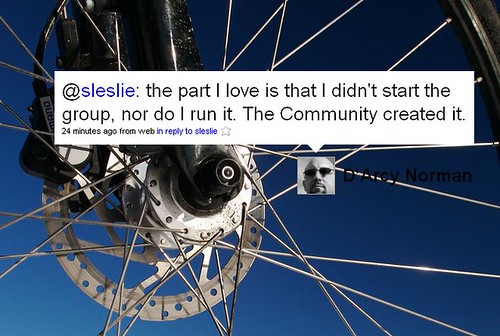
D’Arcy Norman, this morning on Twitter. A sure community indicator.