 It’s time to register for the Connected Futures Workshop that begins April 20.
I’m on the team again this time holding the fort on week 4. My partners in learning/crime are John Smith, Bronwyn Stuckey, Shirley Williams and Etienne Wenger. We are using Howard Rheingold’s Social Media Classroom as our home base this round (we vary each time to add to our own learning!) Note, you’ll get a pre-press copy of the now-infamous and as of yet still unpublished “Digital Habitats: stewarding technology for community” book, plus a 6 month membership to CPSquare. So be there or don’t be square. (Sorry, I could not resist!)
It should be fun. Holler if you’d like more information. Here is the boilerplate!
Connected futures: New social strategies and tools for communities of practice is a five-week workshop for community managers, designers and conveners to explore social strategies and tools to support them (referred to by some as Web2.0). We anticipate offering it twice a year. This workshop is a hands-on, practice-shifting, dive into the use of new technologies to meet community needs. At the end of this workshop, participants can expect to:
- Become more confident in managing and combining tools to support a community’s orientation and ongoing activities
- Develop a deeper understanding of how new tools enable one another, are adopted and supported in communities
- Have productive and lasting social connections with other participants, community leaders and community conveners.
New technology stewards are encouraged to join us. The workshop includes virtual field trips to successful communities and dives into the use of new tools. We will explore many readily available technologies, including web conferencing, teleconferences, blogging, RSS syndication, microblogging, social bookmarking and tagging, wikis, mashups, and social networking. Each aspect has the support of experts and leaders in areas such as organizational, educational, government and enterprise communities. Participants will work through a process of thinking through new social strategies and technologies to support the ongoing life of their respective communities of practice. Participants will also receive an advance electronic copy (PDF) of parts of the forthcoming book “Digital habitats: stewarding technology for Communities ” (Wenger, White, and Smith 2008).
See what previous participants have said about the workshop.
Requirements:
While this workshop is intended to be challenging, it is grounded in today’s reality for communities of practice, social strategies and new tools. We assume some experience with communities of practice and with technologies such as teleconferences, web forums or email lists. Our aim is to support practitioners: participants should be in a leadership role or intending to take one on, or be convening an existing community of practice.
- Participants are expected to be conversant with basic notions such as domain, community and practice and have had experience participating in or organizing online events and learning activities (such as the Foundations of Communities of Practice workshop).
- Participants should be willing to install, run and experiment with an array of tools (such as Skype) on their computers.
- Participants should be confident to converse in English.
- Participants commit to 20 to 40 hours of engagement over the 5 weeks. Since several phases and phase changes are designed into the workshop structure (we change technologies, modes of connecting, and frameworks), participants need to be attentive enough to make those changes with us when they are scheduled.
The workshop includes a lot of modeling by both workshop leaders and participants of learning interactions, stratagems, and tactics using a dozen different social technologies. We are all “teachers” and “learners.”
The workshop is designed to support:
- Getting to know each other and each other’s communities (Community)
- Creating “a workshop as laboratory” (Practice)
- Exploring real communities, from an insider’s and outsider’s perspective to see community orientations & technology integration (Domain and Practice)
- Considering the role and activity of the technology stewards in authentic situations (Practice)
- Exploring the uses of social technologies to stay in touch with each other, as well as for sustained focus on a topic (Practice)
- Experiencing the design of learning agendas and then configuring technology to pursue those agendas (Domain and Practice)
- Articulate strategies to introduce new social technologies to a community (Domain and Practice)
We’re designing the workshop to support:
- Getting to know each other and each other’s communities
- Creating “a workshop as laboratory”
- Exploring real communities, from an insider’s perspective to see community orientations & technology integration
- Considering the role and activity of the technology stewards in authentic situations
- Exploring the uses of social technologies to stay in touch as well as for sustained inquiry
- Experiencing the design of learning agendas and then configuring technology to pursue those agendas
- Articulate strategies to introduce new social technologies to a community
Readings from Wenger, White and Smith’s “Stewarding Technology for Communities” and several other sources on topics such as:
- Communities of practice theory glimpse
- Community technology stewardship
- Tools and their Integration
- Scanning the Technology Landscape
- Orientations: community experience and configuration of tools
- A More Distributed Future
- A Learning Agenda
Tuition is as follows:
Standard rate $995
NGO, Non-profit employee $795
Student $595Participants receive a free 6-month membership in CPsquare upon completion of the workshop.
If money is a challenge in this economy, write me directly to inquire about “FON” discounts. (Friends of Nancy).
Photo Credit: takuya miyamoto
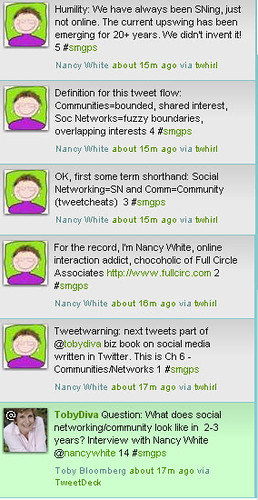 Toby Bloomberg is not the type to let the dust gather. She is always looking at things, asking “what can we do with that” and, rather than just asking, she starts trying and doing. She is a force to be reckoned with!
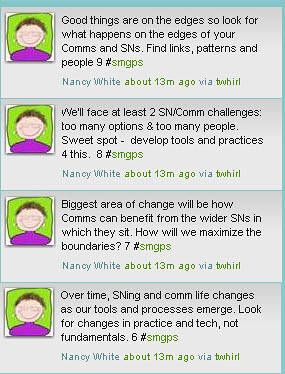 Now that Toby is on chapter six, she has sussed out the process a bit and suggested earlier in the week that preparation is worth it, and that trying to not get carried away with too many tweets is also useful. That asks the writer to be both succinct per post (140 characters) and overall. With the size of the question Toby asked me, that was challenging. How to be brief but substantive, eh? It is harder than it looks.
 Are we pushing a medium too far or is this a useful, creative application? Or something all together different?