Now, more than ever, we need to be able to express facts, ideas and opinions clearly and persuasively. Here is your chance to learn from a pro. Patti Digh has made a great offer!
NEW CLASS: Learn to Write an Op-Ed that Creates Change STARTS JULY 11
We need progressive voices to show up in the traditional media, on social media, in water cooler conversations… It is not enough to feel passionately about issues like gun control, reproductive rights, child hunger, voting rights, LGBTQIA+ rights, disability rights, and a myriad of other issues. We must also be able to articulate our point of view, clearly and concisely. I’ve been thinking a lot about this as an inveterate op-ed writer since I was in the sixth grade. So I am offering a four-week intensive on writing op-eds (which can also be used as Letters to the Editor, blog and social media posts, etc). I hope you will join me. Our voices matter. Go here for info.
Earlier this month on the KM4Dev email list, one of my colleagues pointed to a study comparing F2F and online idea generation in the journal Nature and concluding F2F produced better results.
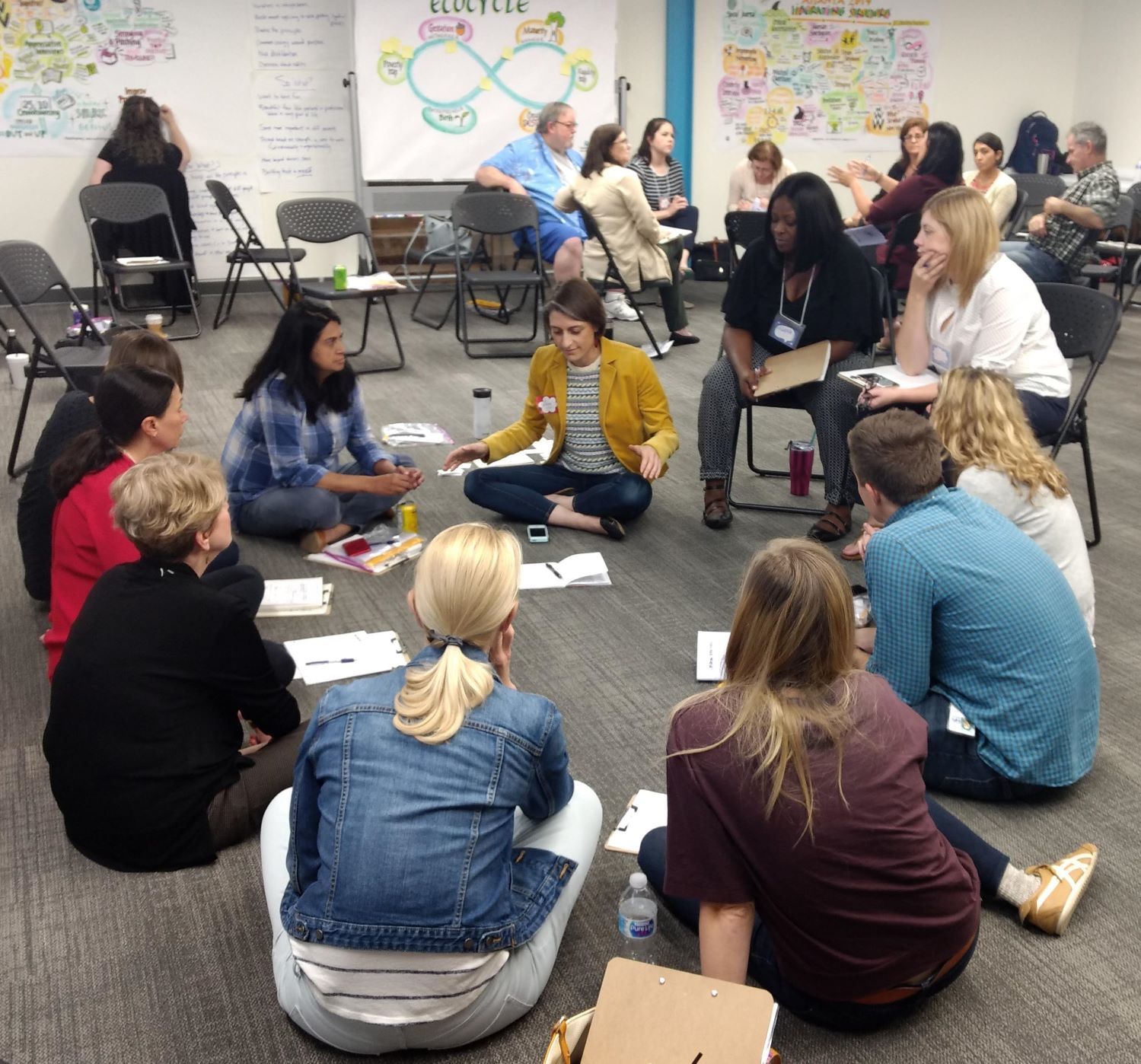
Virtual communications curbs creative idea generation, by Melanie S. Brucks and Jonathan Levav was a fascinating read. The authors did more to test their hypothesis compared to other studies I’ve read which claim one environment or other is better for some function. I take them with the proverbial grain of salt. This one got me thinking more deeply. Here is a bit from their summary:
Departing from previous theories that focus on how oral and written technologies limit the synchronicity and extent of information exchanged4,5,6, we find that our effects are driven by differences in the physical nature of videoconferencing and in-person interactions. Specifically, using eye-gaze and recall measures, as well as latent semantic analysis, we demonstrate that videoconferencing hampers idea generation because it focuses communicators on a screen, which prompts a narrower cognitive focus. Our results suggest that virtual interaction comes with a cognitive cost for creative idea generation.
Brooks and Levav
Narrower cognitive focus! In the example studies, they talked about the power of objects around is in a physical room to help us get creative. We limit those options when we diligently focus on the screen online. Wait, we focus on the screen because that is what we have habituated as proper virtual behavior. “Focus on the screen! Avoid distractions! And then we lose a bit of ourselves. Have you ever had that experience at the end of a Zoom where you have to reground yourself in your physical space?
Broader cognitive focus! Our habits impact our participation and our results. What if it is our lack of imagination and attention to what full presence and participation means that hampers us? What if we invited ourselves to use our F2F external environment WHILE attending to the screen? What if stepping away from the screen was part of the idea generation practice which not only widened our visual cognitive focus, but reawakened our kinesthetic selves?
It is convenient to assume that environment trumps all. And thus we begin to bias our thinking about the issue of F2F vs online options and choices that are so top-of-mind these days.
Maybe we are asking the wrong questions. What if the question was “what kinds of focus most contribute to idea generation?” And THEN ask how that focus can play out across different environments. This might be a great area for experimentation!
There are some bulbs along our driveway that were here when we bought our house in 1984. In the Spring, they put up a bunch of large green, strappy leaves which dry and fade away as the Summer heat comes on. Then, come Autumn, large pink crocus-like flowers emerge. The surprise was delightful the first time and still is, 30-some years later. (Turns out they are probably Giant Colchicum – Autumn Crocus).
From https://www.gardenia.net/plant/colchicum-the-giant
So blogging… I’m not sure if it is because I’m paying attention differently, or if there is something emerging around personal blogging like the crocus. It is alive all year long. It sends up shoots in the Spring then disappears again, and then it flowers. Is a new cycle starting? People whose blogs I used to read consistently but who have faded out over the years are blogging again. There is crosslinking around the topic at hand. Look who is blogging again!! I’m so delighted. (AND: I need a better feedreader, email subscriptions are not as useful, help!)
Blogging is different than participating in social media for me. But it takes more time and attention. It is quieter for the most part. Sometimes solitary. Sometimes it connects. Sometimes it needs the permanency of a url so it can sit, and later, even much later, the flowers can emerge. It is NOT feed of the moment for me.
I wrote yesterday about my Blogiversary. One of the observations was the power of thinking out loud in a blog post and the tantalizing possibility that others may chime in, counter, improve or simply show they were “there” in a comment. As Chris Corrigan noted, the satisfaction is NOT like the (addictive, distracting, destructive) “likes” or “retweets” of FB, Instagram and Twitter. I feel something visceral in this. Cellular versus a visual stimulation that comes and goes in an instant.
Dave Pollard wonders out loud about the role of relationship in our blogging. About how relationships do or do not inform our sense of identity. Euan Semple riffs on the relationship and self knowing. ( I find Euan’s post today on non-identifying usefully troublesome and need to think about what is surfacing for me, about the down side of non-identifying when one is from a dominant culture, race, gender etc. Claiming non-identification can also be an abdication of the negative impact of privilege but that is another topic for pondering.)
What we all have in common is that we wonder out loud in our blogs.
The amazing Tom Atlee wrote a post in 2014 calling for wiser research on collective wisdom. It is a powerful piece of writing and still worth your time to click on the link. What sticks with me is his attention to the need for (and inherent messiness) of including diverse voices in collective wisdom. From the days of George Floyd’s death in 2020 and the voices and conversations that emerged, we need to consider Tom’s ideas more than ever.
Here is a teaser to get you started…
I take issue with another major assumption of the “wisdom of crowds” thesis advanced by James Surowiecki, author of The WIsdom of Crowds – specifically, his bias against conversation, dialogue, and deliberation. Harri Oinas-Kukkonen summarizes that assumption as follows: “Too much communication can make the group as a whole less intelligent.”
This principle exhibits a profound ignorance of the varieties of communication and conversation – an ignorance that prevents researchers in the field from even glimpsing – to say nothing of clarifying – more comprehensive and authentic forms of collective intelligence and wisdom. Most forms of collective intelligence and wisdom are deeply dependent on the interaction of diverse entities, usually in the form of conversation.
When Surowiecki and his followers speak out against communication among the guesstimators in a “wisdom of crowds” exercise, what they are actually speaking out against (without realizing it) are interactions that reduce the level of diversity in the system. What produces the crowd’s accurate collective answers is aggregation of its non-manipulated diversity. This is one way to “use diversity creatively” – a central feature of collective intelligence. But this “wisdom of crowds” aggregation approach is limited to getting collective answers to questions of fact – including predictions (future facts) and currently unknown facts (like the location of a sunken submarine).
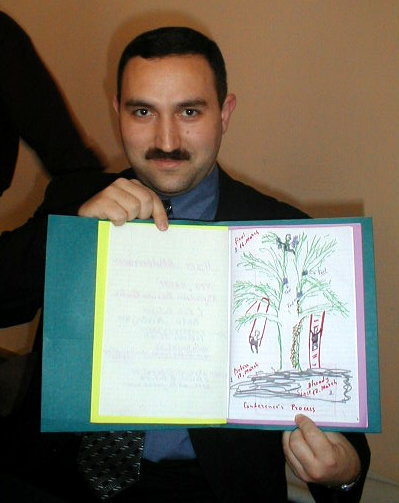
It is encouraging to see this article from 2013 is still online, and is still relevant examining how young people from conflict areas can be connected with each other. And the risks involved. . With the current conflicts continuing in Armenia and Azerbaijan and with the emergent issues in Russia and the Ukraine. It also reminds me of the amazing work I was invited into in the Caucasus with Project Harmony, with the highs, lows and learnings. I was hopeful and naïve – I’ll own that! (Morehere.)
We use cookies on our website to give you the most relevant experience by remembering your preferences and repeat visits. By clicking “Accept”, you consent to the use of ALL the cookies.
This website uses cookies to improve your experience while you navigate through the website. Out of these, the cookies that are categorized as necessary are stored on your browser as they are essential for the working of basic functionalities of the website. We also use third-party cookies that help us analyze and understand how you use this website. These cookies will be stored in your browser only with your consent. You also have the option to opt-out of these cookies. But opting out of some of these cookies may affect your browsing experience.
Necessary cookies are absolutely essential for the website to function properly. These cookies ensure basic functionalities and security features of the website, anonymously.
Cookie
Duration
Description
cookielawinfo-checkbox-analytics
11 months
This cookie is set by GDPR Cookie Consent plugin. The cookie is used to store the user consent for the cookies in the category "Analytics".
cookielawinfo-checkbox-functional
11 months
The cookie is set by GDPR cookie consent to record the user consent for the cookies in the category "Functional".
cookielawinfo-checkbox-necessary
11 months
This cookie is set by GDPR Cookie Consent plugin. The cookies is used to store the user consent for the cookies in the category "Necessary".
cookielawinfo-checkbox-others
11 months
This cookie is set by GDPR Cookie Consent plugin. The cookie is used to store the user consent for the cookies in the category "Other.
cookielawinfo-checkbox-performance
11 months
This cookie is set by GDPR Cookie Consent plugin. The cookie is used to store the user consent for the cookies in the category "Performance".
viewed_cookie_policy
11 months
The cookie is set by the GDPR Cookie Consent plugin and is used to store whether or not user has consented to the use of cookies. It does not store any personal data.
Functional cookies help to perform certain functionalities like sharing the content of the website on social media platforms, collect feedbacks, and other third-party features.
Performance cookies are used to understand and analyze the key performance indexes of the website which helps in delivering a better user experience for the visitors.
Analytical cookies are used to understand how visitors interact with the website. These cookies help provide information on metrics the number of visitors, bounce rate, traffic source, etc.
Advertisement cookies are used to provide visitors with relevant ads and marketing campaigns. These cookies track visitors across websites and collect information to provide customized ads.