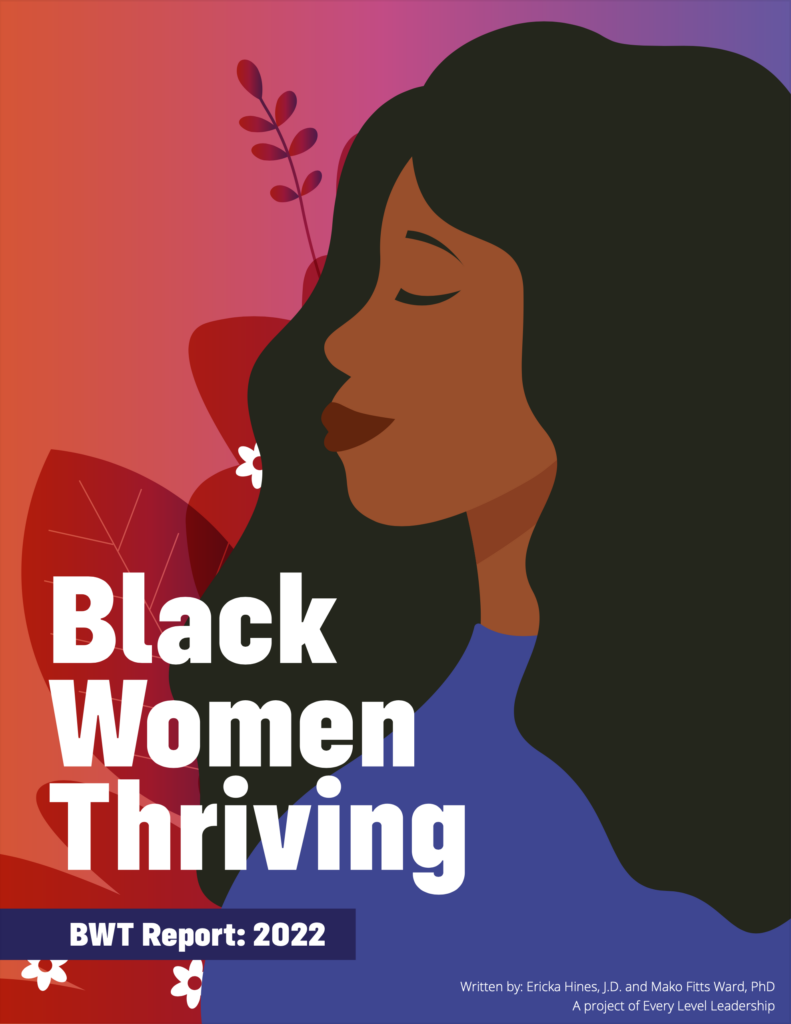
Ericka Hines of Every Level Leadership and her network launched this project to deeply understand and provide data about Black women in the workforce. I’ve just starting reading and already find it full of compelling, clear data and recommendations. So I don’t want to wait to spread the word. From all Ericka’s good work, comes possibility for the rest of us to take action. THRIVING!
Today is my birthday. Always a good time for reflection….
How do we discern what practices to keep and which to throw away? What have we noticed in our changing practices since the pandemic and how do we make the MOST of them? Or not! Are we wallowing in toxic nostalgia?
Dr. David Viscott, author of a book entitled Emotional Resilience, defined toxic nostalgia as “a subtle mixture of feelings, attitudes, perspectives and needs from different ages all showing themselves at once as the unresolved past attempts to define the present.” I found Dr. Viscott;s quote via Rabbi Mike Harvey. Rabbi Harvey also made his own offering describing toxic nostalgia is “thinking that things used to be amazing, focusing only on good memories, and defining the past by those good memories, then projecting the difference between the reality of the present with the imagined reality of your past and seeing the difference. “
Once I started looking, toxic nostalgia shows up in the media a lot lately. I felt resonance. Think about our societal polarization on so many issues. Our blindness as we endorse things that do us harm.
For me and my group process practice we use the term “snapback.” Snapback to the old, familiar, comfortable ways – even if those old ways are no longer serving. For groups working together, the pandemic tossed us out of our familiar ways and ruts and many of us rapidly embraced new ways. Now that things are leaking back into old settings (i.e. F2F offices, meetings) the snapback is showing up. I’m noticing that some of the groups I worked with during the pandemic where they created and adopted new, productive practices, are slipping back into high control, low liberating practices.
If we don’t examine and compare our practices, we may default to toxic nostalgia and snapback. Or we can stay awake, notice what has changed and how that change has or has not positively impacted what we are trying to do together. We fear “falling off the horse,” but perhaps what we should fear is not noticing with either got back on or fell off the horse and learned NOTHING!
From the draft posts I’m mining, I reread a fantastic 2008 post by Konrad Glogowski on his blog, Towards Reflective BlogTalk.
Remember blogs? Well, even if folks no longer blog per se, there is still a lot of writing we put out on the interwebs.
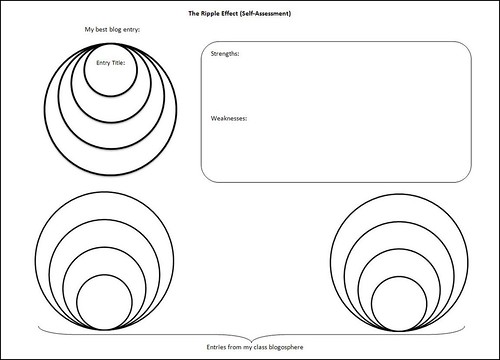
I was taken by his description of a reflective process he developed for his 8th grade students and their blogging. As I read it back in 2008, I immediately put his ideas into this stewpot of “5 minute reflective practices” I had had simmering in the back of my brain. I thought what Konrad wrote about could be used in teams and communities of practice, as well as in classrooms. With a few adjustments, it might be a very fine tool. This idea of “ripples” is very powerful.
Konrad wrote:
It’s not enough to know how to grow a blog, to pick a topic and keep contributing to one’s blog. Our students must also be aware of the class communities in which they learn. They have to have opportunities to think and respond to other writers. They need opportunities to engage in and sustain conversations about their own work and the work of their peers. Blogging is not about choosing a topic and writing responses for the rest of the term. It is about meaningful, thoughtful engagement with ideas.
You’ll need to go read the full post for the method. He links to his worksheet here.
All these years later, reflective practices remain useful and at the core of my process repertoire. Currently Keith McCandless and I are working on a draft of a new Liberating Structure (Strategic Knotworking) and we both feel strongly that evaluation should be woven into work from the start, not just at the end. I suggested that this is a form of reflective practice. I turn often these days to the work of the fine folks building the field of Developmental Evaluation (Michael Quinn Patton and many others), and to the work of Etienne and Bev Wenger-Trayner and their Value Creation Framework and subsequent book, Learning to Make a Difference.
Yes, it is about meaningful, thoughtful engagement…
Note: Last September I co-led a Liberating Structures Immersion in Atlanta and met Dr. Mari Dumbaugh, BA MSc PhD, Founder & Lead Consultant, Insight Impact Consulting, Adjunct Instructor & Research Associate, University of Illinois-Chicago. I was so enlivened by her follow up comments, I asked to interview her. It took us a while, but enjoy what she has made possible in bringing LS to her international development work!
What happens when you discover something that simply resonates for you? Mari Dumbaugh, qualitative program evaluator, training facilitator and professor of Global Health, had that experience by the end of the first day of a two day Liberating Structures immersion workshop in Atlanta last year. The moment of clarity came towards the end of the day when she was sitting with two others in a Troika Consulting exercise. Troika allows each person to get help on a challenge – no matter who they are sitting with. In the span of twenty minutes, Mari received significant feedback and ideas. “In just a day I discovered how accessible the structures are, and with the immersion – even one day – I could walk away with concrete things I can do across settings and cultures.” She also discovered things she had in common with two people who were before perfect strangers– both were also independent female consultants, looking to engage their clients in innovative, interactive ways. These two strangers-turned-colleagues inspired Mari to shift her entire approach to her facilitation and training work.
Mari realized she could make radical changes in how she was going to deliver her next training of qualitative research teams two weeks after the immersion. In the span of a few days she redesigned her training program from a primarily content delivery mode to an “unleash and engage everyone” mode using Liberating Structures.
Mari shared, “Often I’m facilitating training in settings where participants are coming from didactic education systems with few experiences of real engaged, classroom interactions. They are used to just taking notes of what the professor says. So their starting expectations were different. They were used to sitting around tables and expecting to be filled with knowledge!” One thing her Troika group suggested was to get rid of slides. Mari was very open to the idea – she was not a huge fan of PowerPoint. As a university lecturer at a public university in Illinois, she found slides a convenience. There was some hesitation to dump the PPT all together because like so many of us, it had become a crutch. A safety tool.
And then she left for a remote part of the Central African Republic to run a Qualitative Research training workshop for a group of individuals with varying degrees of research experience. For some workshop participants this would be the first time they heard the term qualitative research. The training and subsequent program evaluation would take place in an area where there was often no power (no PowerPoint), a ton of material to cover, and on top of it all, she would be working in French! Did she regret missing day 2 of the immersion? I don’t think so. Mari was on FIRE!
Civil society and education systems in the Central African Republic have been rocked from general lack of funding and the most recent civil conflict that began in 2014. Education systems have been completely interrupted, and Mari was working with people with varying levels of literacy. It was clear to her that having participants write down notes, word for word from slides, was not an efficient way to learn.
The transition was not always easy. “When I tried interactive activities on Day 1 of the training, it was hard to pull people out of the structured classroom expectations.” But by ditching most of her slides, she also ditched the stress of not knowing when the power (and thus PPT) might go off. So she got rid of it entirely! She delivered a full 5 days of training with her newly created workbooks she printed in Chicago and carried with her on the 7,000 mile journey to Berberati, Central African Republic..
The workbooks featured all of the qualitative training content and content Mari used in previous trainings, but now with Liberating Structures as the vehicle for a more participant-engaged delivery. Some of the foundational qualitative content came straight from her previous slides, and other parts were left open to build on the participants’ knowledge, perceptions, questions and experience. A number of Liberating Structures lend themselves seamlessly to teaching qualitative research techniques, so participants had the chance to experience some structures and think about how to use them in their field research work.
Here are some of the structures (both established and emerging) Mari used and how she used them. I felt the detail was worth the longer reading time. 🙂
Spiral Journal – To emphasize the centering of participant voices from the very beginning of the workshop, Mari began the workshop asking participants to reflect and journal on their previous relevant experiences and why the group was lucky to have them as part of the research team. Journaling sessions served as the foundation for a number of LS strings throughout the workshop, includingImpromptu Networkingand1-2-4-All.
1-2-4-All – From creating a Community Collaboration Agreement to establish agreed upon ground rules and parameters for our workshop together (i.e. mutual respect…and turn off those cell phones!) to reflecting on what participants took away from the Celebrity Interview, 1-2-4-All was an excellent way to get participants reflecting, sharing, benefiting from all of our diverse perspectives and previous work and co-creating the workshop experience. Mari strung 1-2-4-All after a Celebrity Interview, a Spiral Journal session or as a way for participants to generate questions about the material being covered. Mari reflected that this structure was especially helpful in moving away from PowerPoint-centric teaching and facilitation. After participants shared their own perspectives, Mari was able to expand upon, gently redirect and/or insert new information around what participants already knew or shared.
Celebrity Interview – To introduce the foundational concepts and associated skills of qualitative research Mari had great success using an expert “Celebrity Interview.” “I served as the ‘expert’ and gave my colleague questions to use in the ‘interview’ so that I could introduce the basic concepts of qualitative research…while also modeling in real time how to conduct a quality interview!”
Mari followed the Celebrity Interview with 1-2-4-All. First, participants individually reflected on what they learned and observed during the interview, then shared with a partner, and finally merged into a group of four. By the end of the activity the group had collaboratively formulated a list of key concepts and competencies and Mari filled in any gaps with anecdotes from her own field experience – even acting some of the anecdotes out! The entire activity was so personal and rooted in the lived experiences in the room. The key was that the participants had ownership over the process. In reflecting back on the experience, Mari shared “It felt liberating for me as an instructor. I know this stuff, of course. I have a PhD. But with PPT slides you feel you can’t break away from them. All the knowledge in the slides is IN me and I can deliver without slides.”
Mari also learned some other things from the Atlanta workshop. “We had someone illustrating the entire session, an artist who put a visual to every activity we were doing. I thought about how to do this to give my qualitative researchers some context about their work. I had to explain this complex intervention we were evaluating. I decided to do it as a visual. I practiced ahead of time with a colleague. I visually drew out each of the stages of a relatively complex intervention. I know this sounds simple, but it flips our way we have traditionally developed teaching and learning. That has been dry, and not multisensory. This flips it on its head and is shockingly different ways of looking at the world. In 15 minutes I clearly shared, and they saw where they fit into the picture.”
In the end, Mari felt they had accomplished something huge. “It felt like a collaboration, instead of me just delivering information and being in hierarchical power and knowledge relationship. We were collaborating together as a team. We asked much more and more engaging questions.”
Of course, some form of didactic information transfer is necessary, especially when introducing concepts or skills to a group. Mari wanted to make sure participants left the workshop with consistent information in print. Yet she worried that by printing workbooks of what was in her previous training slides people would just fall back into “receiving mode.” Her solution was to print text that conveyed foundational concepts, but bring along highlighters for each participant. “There was an exercise to highlight key concepts and words as we went through the stages. This played well into the Liberating Structures. Then they discussed between and amongst themselves. In the end, I avoided having participants writing out information or having an extreme amount of reading. There was just enough of both to engage them.”
When I talked to Mari, I asked her to think about the moment when she was able to say “yes” to shifting how she did this work. “I was feeling the support and enthusiasm at the immersion, and it buoyed me a lot. I participated and went through the activities, and not just a superficial way, but in a way that gave me concrete, applicable strategies. I saw the structures worked.”
“Troika Consulting was especially helpful. By the grace of universe to be paired with two women from different fields but both consultants, we were able to communicate similar challenges across our fields where we need to communicate information that isn’t always so exciting. They gave suggestions with confidence,” recounted Mari.
Liberating Structures constantly talks about engaging and unleashing everyone. I asked Mari if her workshop participants in Central African Republic started to have access to their own expertise? “Yes, [after 3 days of classroom training] we started with a pilot study to test the research tools and give the workshop participants experience before the “real” data collection phase. Comparing this experience to a previous (successful) ppt based training, the reactions were very different. The team from CAR came back from the field more animated and excited about their roles as researchers. It got them excited about their role, to apply the role to themselves and built confidence for conducting the research. They too can do this, even just having been introduced to qualitative research. After three days built using LS, they came back with huge smiles on their faces. And they were motivated to continue.” During the training session immediately following the participants’ pilot field experience Mari used Spiral Journaling and 1-2-4-All to encourage personal and group reflection. Participants shared challenges they encountered during the pilot study and the group generated ways to address the solutions during upcoming data collection together.
We talked about what happened after Mari left, what she did to support her CAR colleagues’ new skills and confidence. “I left them with something… the workbook that they actively contributed to creating and added along the way. They have a resource to go back to should they confront challenges and opportunities (even in different contexts).” Mari also added that a number of participants expressed a palpable enthusiasm and deep understanding of the importance of qualitative research. Mari believes the collaborative and experiential approach to the workshop played a huge role in communicating the power of qualitative research to workshop participants in a profoundly personal way that is not always possible with a more traditional, didactic approach.
Mari sees the power and applicability of Liberating Structures. “ LS needs to be introduced to more NGOs in general, especially in contexts like Sub Saharan Africa where many systems are still scripted, where the leftovers of colonial approaches remain. As far as engaging individuals, NGOS could really benefit from having these trainings brought to local levels.
What is Mari’s next step? “Attend more immersions! Experience more of the structures myself. My next step is looking at my next semester of teaching. I get mostly great reviews, but the class could benefit from more engagement and less straight lecture. I want to learn how to integrate more structures into my classroom teaching.”
From training, to university teaching, to consulting – Mari doesn’t stop. “I want to refine and develop my LS skills for my consulting as well.” Mari is interested in how immersions can help spread LS. “The immersions and the ways you apply them into your setting depends on your group. I love that creativity – react to the group you are with. It keeps me on my toes. While I can plan, I can also leave space for creativity to emerge. Of course, vulnerability is required. The structures allow it.”
Note: After this interview Mari went on to facilitate a training of qualitative researchers from both Malawi and Ethiopia in Addis Ababa. Liberating Structures – and the lessons she learned from her workshop Central African Republic – formed her approach to training a group of experienced researchers, many of whom were university professors themselves! The workshop and subsequent data collection were great successes, proving yet again that these approaches are flexible and translatable across context and levels of experience.
Mari has also maintained a personal and professional relationship with one of the Atlanta Immersion participants who was in her Troika group – they exchange on their experiences using LS in different workshops and hope to collaborate in future to bring LS Immersions to more of their circles.
Designing in complex and emergent contexts challenges the traditional log frame approach. With a set of Liberating Structures we can create a more adaptive and actionable strategy for project design and development that contextualizes the plan into a fuller picture of the landscape within which it operates. This is a very belated follow up on the application of the process with the good folks at the University of Illinois for the INGENEAS project where we used this approach in April.
Liberating Structures are easy-to-learnmicrostructuresthat enhance relational coordination and trust. They quickly foster lively participation in groups of any size, making it possible to truly include and unleash everyone. Liberating Structures are adisruptive innovation that can replace more controlling or constraining approaches. They are engaging, easily learned and replicated and “complexity friendly.” To learn more about Liberating Structures, please visit http://www.liberatingstructures.com.
With a fully engaged and flexible approach, challenges such as complex international development projects can work with emerging contexts, rather than struggle against them. Business with rapidly changing markets can develop a portfolio of approaches to respond quickly and accurately.
As a process, participants in all parts of a system can engage, probe and sense on the ground, and loop the learning back into the strategy e for iterative improvements. Monitoring and evaluation approaches that require flexibility to work in complex contexts are designed as part of the landscape, not afterwards.
Framing the strategic planning as an adaptive landscape versus a document situates the work in its complex setting. By complex, we mean we may not be able to predict outcomes, even with extensive expertise, and only understand causality after the fact. For example, most international development work operates partially and sometimes mostly in complex settings. So the use of complexity-based approaches helps us work more productively and adaptively in these contexts.
The Six Essential Questions of the Adaptive Strategy Landscape
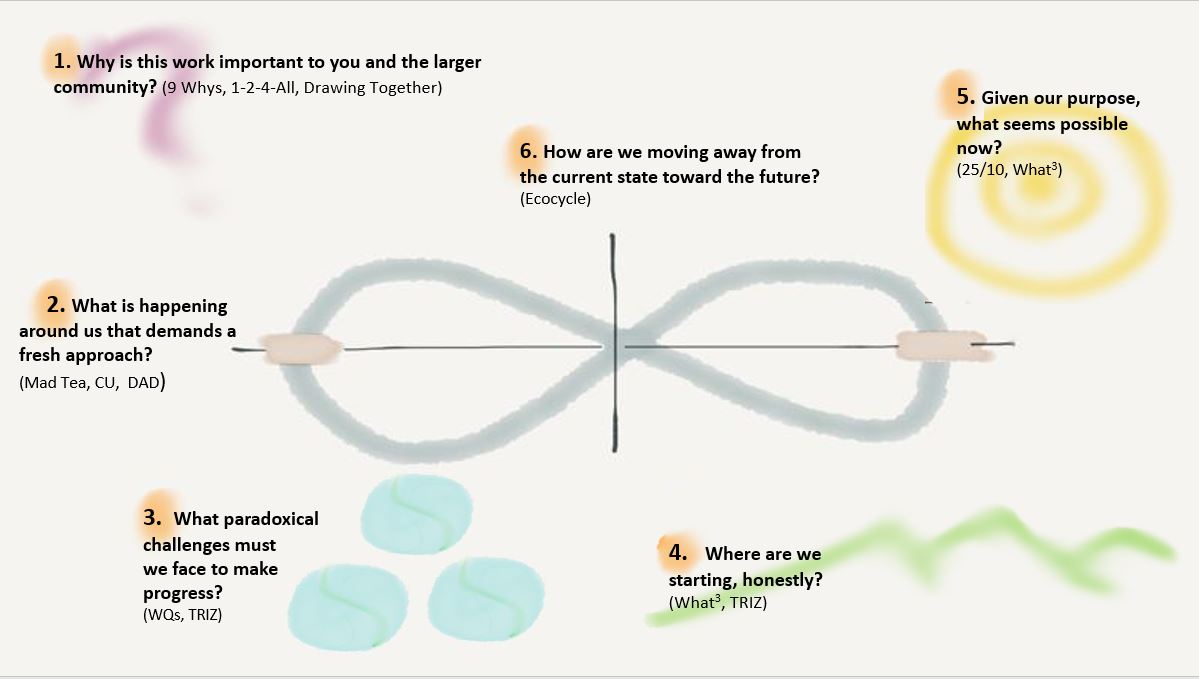
The strategy landscape, or “knotworking” as it is increasingly called, is framed around six essential questions and held together through the Ecocycle. These questions frame, drive and help us evaluate our strategy.
PURPOSE: Why, why, why is this work important to us and the wider community? How do we justify our work to others?
CONTEXT: What is happening around us that demands a fresh/new/novel approach (creative adaptation and change)?
BASELINE: Where are we starting, really?
CHALLENGE: What paradoxical challenges must we face to make progress?
AMBITION: Given our purpose, what seems possible now?
ACTION & EVALUATION: How are we moving/breaking away from the present and moving toward the future? How do we know?
The questions, particularly the focus on purpose and ambition pull a group into possibilities as they make choices and identify next steps. While they seem linear, there are feedback loops. As the group discovers new things, they may come back and modify earlier “answers.”
The Ecocycle
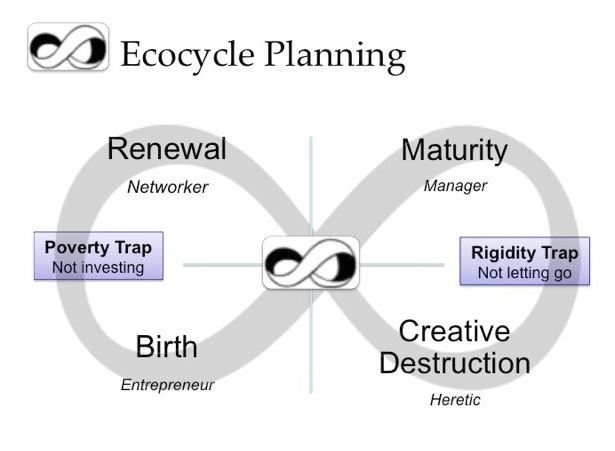
The Ecocycle provides the glue across the six questions and helps us recognize that we are always working in emerging contexts. To fully exploit knowledge and practice that has been vetted and ready for scale (maturity), we also have to pay attention to what is no longer adding value (creative destruction), what is needing to be birthed (networking) and then iteratively developing those ideas (birth) until they reach their own maturity. The Ecocycle illuminates the pulling from gestation to birth to maturity to creative destruction where strategy-and-tactics are combined. A new mindset pops into view. It can also help assess current state of activities, assets, relationships and resources, as well as identify future possible actions.
Strings for Each Question
Liberating Structures are most often used in a combination. The six questions are engagingly answered through a series, or “string” of Liberating Structures. There are a range of structures that can be used for each question. Here are some examples:
PURPOSE: Why, why, why is this work important to us and the wider community? How do we justify our work to others?
9 Whys – Make the Purpose of Your Work Together Clear. When we dig into our assumptions, our true purpose may reveal itself – and surprise us!
1-2-4-All – Engage Everyone Simultaneously in Generating Questions, Ideas, and Suggestions. Thinking alone, clarifying in pairs then building a sense of ideas across larger groups help us step beyond the “usual” ideas and observations and facilitate input from all – even the quiet folks.
Drawing Together – Reveal Insights and Paths Forward Through Nonverbal Expression. We tap into different parts of our brain, may reveal new insights and prevent jumping to premature judgement or closure.
CONTEXT: What is happening around us that demands a fresh/new/novel approach (creative adaptation and change)?
Mad Tea – Connecting with others to reveal surprising truths and action steps. Using rapidly rotating paired conversations, we also provide a smaller, safer space to reveal initial ideas, fears, and issues.
Discovery and Action Dialog – Discover, Invent, and Unleash Local Solutions to Chronic Problems. We build on our strengths, even the ones we didn’t know we had!
What, So What, Now What? – Together, Look Back on Progress to Date and Decide What Adjustments Are Needed.
TRIZ – Stop Counterproductive Activities and Behaviors to Make Space for Innovation.
Critical Uncertainties – Develop Strategies for Operating in a Range of Plausible Yet Unpredictable Futures. We get out of our “thinking ruts.”
Note:The baseline also gives us a starting point for monitoring and evaluation design at the start, not the end of our work!
CHALLENGE: What paradoxical challenges must we face to make progress?
TRIZ – Stop Counterproductive Activities and Behaviors to Make Space for Innovation. It is amazing how liberating it is to STOP something. We do too much adding…
Wicked Questions – Articulate the Paradoxical Challenges That a Group Must Confront to Succeed. Finding the AND instead of the EITHER/OR.
AMBITION: Given our purpose, what seems possible now?
25/10 Crowd Sourcing – Rapidly Generate and Sift a Group’s Most Powerful Actionable Ideas. Get some initial ideas on the table rather than trying to design the perfect solution. Especially by committee!
15% Solutions – Discover and Focus on What Each Person Has the Freedom and Resources to Do Now. Empower immediate action, results and iterative improvement.
Troika Consulting – Get Practical and Imaginative Help from Colleagues Immediately. Sharpen ideas for launch.
ACTION & EVALUATION: How are we moving/breaking away from the present and moving toward the future? How do we know?
What, So What, Now What? – Together, Look Back on Progress to Date and Decide What Adjustments Are Needed. At the micro or macro level, for process and for the actual work or practice.
Ecocycle – Analyze the Full Portfolio of Activities and Relationships to Identify Obstacles and Opportunities for Progress. Situate the work.
WINFY – Surface Essential Needs Across Functions and Accept or Reject Requests for Support. Identify how we work together practically and honestly.
Purpose to Practice – Design the Five Essential Elements for a Resilient and Enduring Initiative. Get the work GOING!
The Visual Canvas
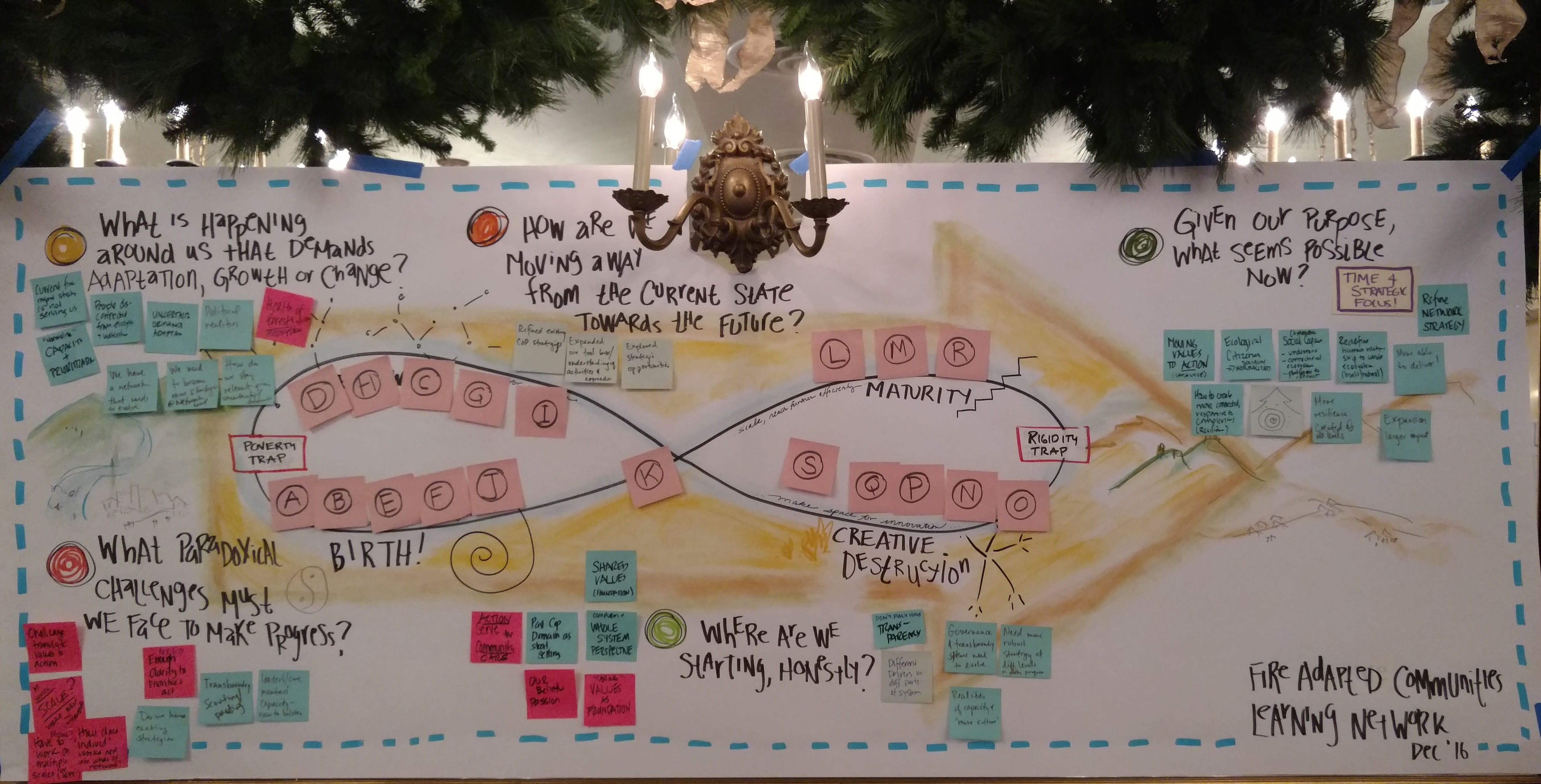
When working in complex contexts, there is often a lot to track and wrap one’s head around. Some of these things are simple next steps, clear data, and identified issues. Others are less certain. We have developed a visual canvas with Ecocycle at the center, surrounded by the six questions for capturing and making sense of the most important findings of the group as they work through the process. Keeping both the questions and the Ecocycle visible throughout the process helps ground and reground as the group progresses. Often post it notes are used so that as new data, insights, and challenges are surfaced, the canvas can be updated. At the end, there is a “story spine” that can support the telling of the strategy story to others.
The visual can be on a large piece of paper on the wall for face to face groups, or a digital artifact online with movable digital notes.
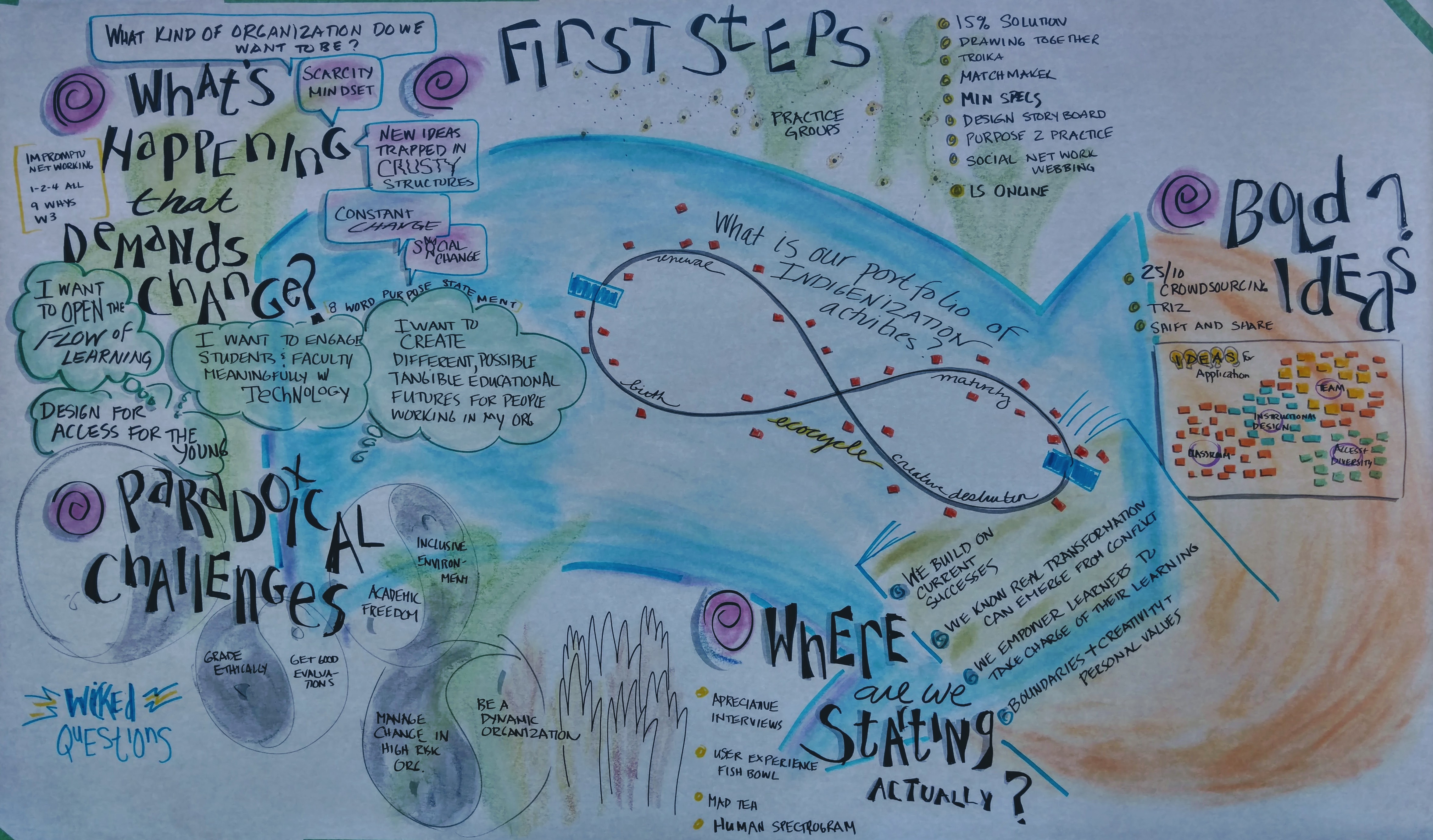
Examples from Other Groups
I have used this approach with a number of groups over the past three years. The results have been:
From the Fire Adaptive Communities retreat
Surprising – One group not only entirely rethought their approach, but the use of Liberating Structures also reshaped their process.
Fast – Quick, iterative interactions revealed far more than traditional SWOT approaches. People are usually amazed at how much they can get done in a day in developing their strategy and implementation.
Possibly threatening – If one or more people come in to the process thinking they know the outcome and their agenda will prevail, this approach can destabilize them and stimulate sabotaging. It is important that everyone knows that Liberating Structures engage and unleash everyone and if you open that Pandora’s box, you need to be ready to listen to and respond to that engagement.
New questions – Some of the things that have surfaced in this work include: how to mine the past without falling into thinking traps in complex contexts where the past may not help us understand our path towards the future; understand how this approach supports and makes visible the decision making processes and finally, how to weave it into developmental evaluation.
Inspirations/Resources
This was developed off of the initial inspiration from Keith McCandless, co-founder of Liberating Structures, and conversations with Fisher Qua and Eva Schiffer. The first draft was developed to support a strategic planning workshop at the University of Illinois for the INGENEAS project.
We use cookies on our website to give you the most relevant experience by remembering your preferences and repeat visits. By clicking “Accept”, you consent to the use of ALL the cookies.
This website uses cookies to improve your experience while you navigate through the website. Out of these, the cookies that are categorized as necessary are stored on your browser as they are essential for the working of basic functionalities of the website. We also use third-party cookies that help us analyze and understand how you use this website. These cookies will be stored in your browser only with your consent. You also have the option to opt-out of these cookies. But opting out of some of these cookies may affect your browsing experience.
Necessary cookies are absolutely essential for the website to function properly. These cookies ensure basic functionalities and security features of the website, anonymously.
Cookie
Duration
Description
cookielawinfo-checkbox-analytics
11 months
This cookie is set by GDPR Cookie Consent plugin. The cookie is used to store the user consent for the cookies in the category "Analytics".
cookielawinfo-checkbox-functional
11 months
The cookie is set by GDPR cookie consent to record the user consent for the cookies in the category "Functional".
cookielawinfo-checkbox-necessary
11 months
This cookie is set by GDPR Cookie Consent plugin. The cookies is used to store the user consent for the cookies in the category "Necessary".
cookielawinfo-checkbox-others
11 months
This cookie is set by GDPR Cookie Consent plugin. The cookie is used to store the user consent for the cookies in the category "Other.
cookielawinfo-checkbox-performance
11 months
This cookie is set by GDPR Cookie Consent plugin. The cookie is used to store the user consent for the cookies in the category "Performance".
viewed_cookie_policy
11 months
The cookie is set by the GDPR Cookie Consent plugin and is used to store whether or not user has consented to the use of cookies. It does not store any personal data.
Functional cookies help to perform certain functionalities like sharing the content of the website on social media platforms, collect feedbacks, and other third-party features.
Performance cookies are used to understand and analyze the key performance indexes of the website which helps in delivering a better user experience for the visitors.
Analytical cookies are used to understand how visitors interact with the website. These cookies help provide information on metrics the number of visitors, bounce rate, traffic source, etc.
Advertisement cookies are used to provide visitors with relevant ads and marketing campaigns. These cookies track visitors across websites and collect information to provide customized ads.

 From the draft posts I’m mining, I reread a fantastic 2008 post by Konrad Glogowski on his blog,