Note: Faciliplay: Play as an Online Facilitation Technique was a post I wrote way back in the early life of this blog, before I moved to WordPress. A lot of those posts feel lost, so I’m picking a few and reposting them. Some, like this one on play, need updating or at least contextualizing. This was written in the day when online interaction was centered on discussion forums, so the advice is framed in that context. It is almost quaint. Today we can imagine and improvise a much broader repertoire of faciliplay. If you have any great examples, please add them in the comments.
Faciliplay: Play as an Online Facilitation Technique (in discussion forums)
by choconancy
First of all, the members of the Fall 1999 Knowledge Ecology University (now defunct) Online Facilitation Course inspired me write this. Their wonderful expressions in “Just Three Words” confirmed what I’ve felt for a while that play can be a liberating, powerful tool for groups and individuals.
The online manifestations for play are varied. Like offline humor, we need to take care that our choices respect or bridge personal and cultural differences. Segmentation of “playful” spaces and activities help maintain topical and project work in the “serious” spaces. The terms “playful” and “serious” don’t need to be so separate, so inviolate. They can be merged with some attention to group dynamics. But that’s for another time.
What I’d like to share here are some resources on incorporating play into your facilitation repertoire for online conference/discussion spaces; a “bag of toys,” if you will, which you can spread out on the “virtual table.” These are primarily for use in asynchronous bulletin boards or discussion forums but if you use your imagination, I bet you can find many other ways to use them.
As background on the use of play in facilitation, you may wish to check out Bernie DeKoven’s “Deep Fun” site at http://www.deepfun.com. Bernie is the author of The Well-Played Game. Bernie has created a playground to share ideas on play for facilitators, therapists and healers. Check it out. Add your ideas. Let’s play!
 Playful Topics
There is a rich tradition in online play topics from social communities across the net. Many of them became “institutions” at such places as the http://www.well.com, and other communities. Here are some examples:
- Just One Word/Just Three Words: as the topic explains, each post has a word limitation. This creates a quick interaction opportunity, allows each poster to “riff” of the previous and can spawn some interesting creative runs. Good for freeing up thinking while brainstorming or using other divergent, creative facilitation strategies. Safe place for anyone to post… you don’t have to create a great literary piece to post! If you want to ratchet it up a notch, try approaches like “rhyme two lines:”
It’s better to jump in and try it yourself
Than let a forum linger, closed, on the shelf…
- The Never-Ending Story/Limericks, and other Continuation Topics: Group creation of a story, poem or limerick draws people back because they want to see how the next person has built on their contribution. This also demonstrates how responding to others and reciprocity can help build the group. Plus, it can be a creative kick in the pants. In watching these topic grow, a facilitator can also get an idea of what type of team player each participant might be. There will be those who will adhere to the story line, and those who always veer. Both are important parts of a group. But it’s nice to know who is who, eh?
- Community History Topics: Online architect Amy Jo Kim is a strong proponent of a community “backstory” or history. By providing space for the group to record and comment on the history, to actually create it, you can provide ownership and a place to be “seen” by the community through specific additions to the record.
- Bars/Grills/Coffeeshops: Hanging out, shooting the breeze, playing around with simulacrums of food and drink is very engaging for a portion of your group. These places are safe spots to let us slowly reveal more about ourselves, both in and out of our “task” or “work/business” concepts. They provide some metaphorical “body language.”
- What Are You Reading/Eating/Thinking: Easy places to drop information, have fun without a high intellectual or time overhead. And get great tips on new books, movies or chocolate recipies. Good for longer term communities and groups. These topics don’t build the critical mass in shorter, time-delimited settings unless, of course, it is a topic about chocolate (only kidding…)
- Confess and Be Absolved: Sometimes you just need to get it off your chest. Master storyteller Paul Beleserene of Vancouver BC started this topic in the old Electric Minds. It was a people magnet. It could be funny, poignant, it could be a safe way to apologize to a fellow community member. And Paul, as host, absolved every single person and sent him or her on their way feeling just a little bit better about themselves. I confess I still love this topic.
Playful Applications of Interaction Spaces
- Bulletin Boards/Forums/Discussions: Consider creating a segment of your online space for play to ensure it doesn’t jeopardize your “serious” topics. Not everyone likes to goof around. Make sure your names reflect the purpose of those spaces.
- Chat: Provide open chat room areas for people to spontaneously chat and get to know, talk about non-project issues or just goof around. Schedule chat times for the group as a coffee klatch or cocktail party as a “get to know” function.
- Instant Messengers: Quick compliments, silly one liners or a quick emoticon wink can create deeper context for your more serious, recorded activities in a conference. Find a place to share IM contacts.
Playful Communications Tools
- Emoticons: There are tons of emoticons that serve as text “body language.” Some disdain them, but it is helpful to include a little 😉 if you are using irony or sarcasm in the space where tone and facial expression are absent. Here are a few along with some acronyms commonly used online:
🙂 or 🙂 are smiley faces composed of a colon and a right parenthesis mark
😉 or 😉 or or ;-> is a more tongue in cheek smile, wink, employing a semi-colon
:O = surprised face (and there are hundreds of variations)
<g> = grin
D or 😀 = big grin
:/ or :-/ = chagrin, disappointment, etc.
🙁 or 🙁 = frown
btw = by the way
imo = in my opinion (or imho = in my humble opinion)
rotfl = rolling on the floor laughing
lol = laughing out loud
For more emoticons, see Emoticons: Online Body Language
- Images and Fonts: Sometimes adding a little color or images to a communication can help enhance a message. Here is one of my favorite animated gifs that a member of one of my online communities made in reference to people getting a wee bit too touchy about issues and feeling attacked:
 Image courtesy of Steve Ruano, ©1999 (alas, gif is gone!)
- Snarfs and Post-a-thons: These are really down-and-dirty techniques that are not for just any online interaction space, but for die-hard online addicts. Most often found in purely social communities, they can inspire quite intense participation and engagement. Now, definitions! A snarf is a post with a particularly toothsome number. Century snarfs (100, 200, 300) are pretty common in big, public communities. Big K’s (1,000’s) are rarer and more prized. Then there are the other odd number combinations which include repeat numbers (555, or the infamous Karen Valentine snarf — 222), numbers with other significance (777, 69) or sometimes people like to snarf numbers that have personal significance like birthdays (51558) or anniversaries. It is totally silly. It can catch like wildfire. It can also destroy the experience for those who do not like snarfing. Consider yourself warned.Post-A-Thons are group efforts to drive up the number of posts in a topic. Again, this is a social community thing. Don’t ask me. I’ve done it. I confess. I really burned out a wrist one weekend trying to get 7,000 posts in one topic as a form of social protest to site management’ capricious decisions at a community that will go unnamed. But you would be amazed how it builds a group over a short period of time. Kind of like a strong, addictive drug. Again, you’ve been warned…. 😉
The best way to understand these playful applications is to visit some online communities and join in. (ALAS, so many of these are gone!) Check out http://www.electricminds.org, (especially the Playground conference),http://www.salon.com (click on Table Talk) or http://www.utne.com . And have fun!
Image of purple lady from Jeffrey Zeldman Presents
 Last month I finally got a chance to use a facilitation activity called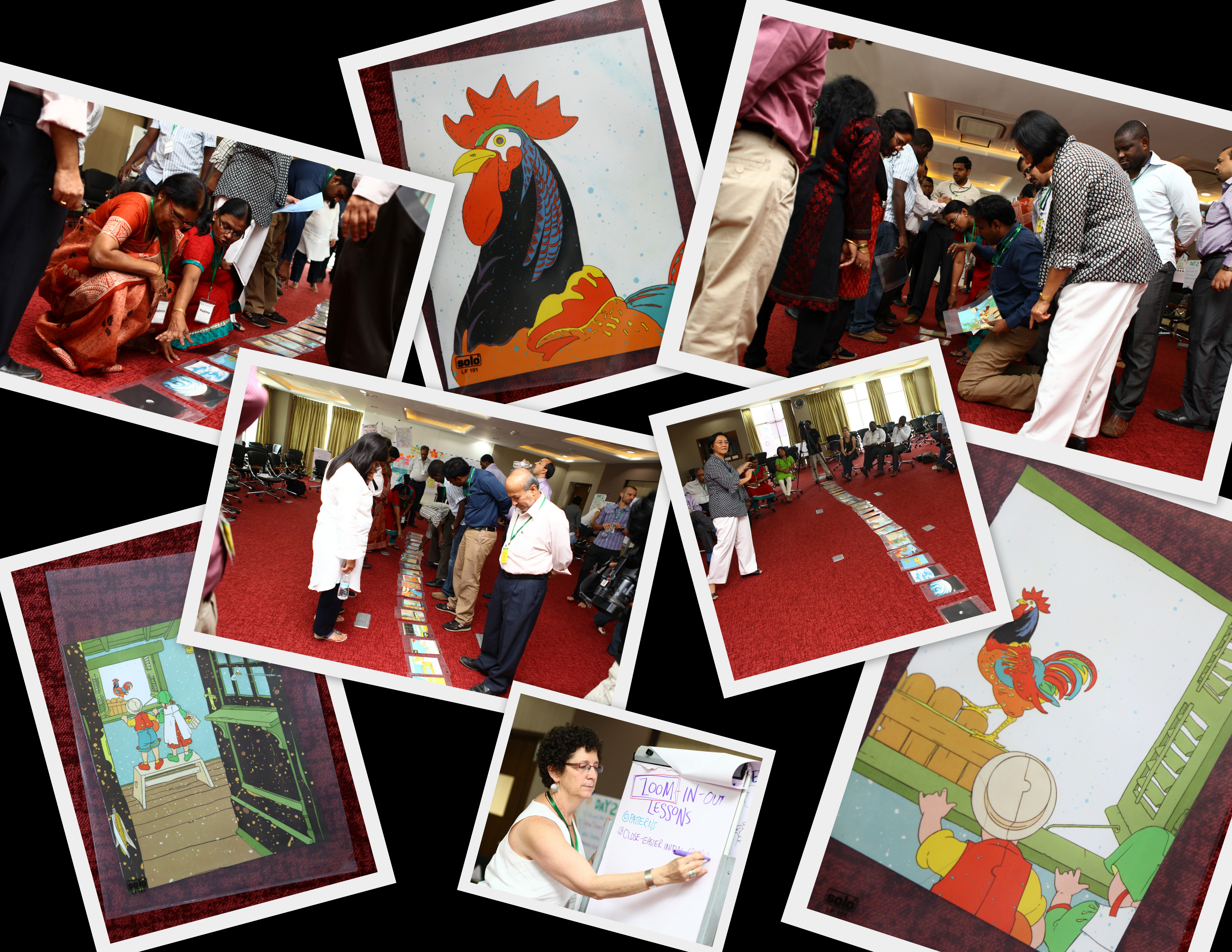
 Take a minute to read this great post from Bob Sprankle (who says he is an elementarytechnology integrator – wow, that’s a new one on me!)