Sunday, April 30, 2006

MindCamp 2.0 Wrap Up


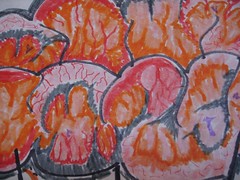
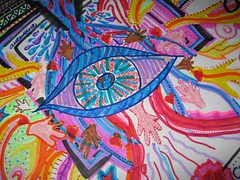
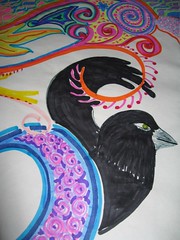
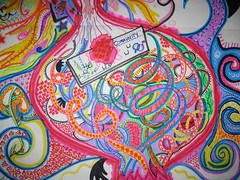
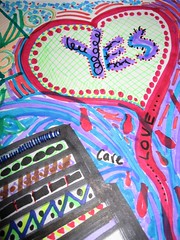
We finished up the collaborative drawing at MindCamp 2.0 just as we broke. There are folks with better cameras who will flicker their pictures so we can read the notes included in the image - including the group's feedback at the end of highlights and things to consider next time. I've tried to put them in sequence so you can see the image emerge on MindCamp 2.0 Collaborative Drawing - a photoset on Flickr.

I wanted to capture my hightlights too, before I took a nap. (MMMMMMM.)

* I went with a tweaked back and sore right wrist. Kate Dumortier of Unwind was offering chair massages Saturday evening and she was heaven sent. If you own a company in Seattle or London, check out her corporate stress management program. It gave me back energy so I could continue to enjoy the evening and pain free! This is an unsolicited and greatful plug!
* Sessions that set the stage for 2-5 minute short rounds of ideas and presentations. Jumpstarting the brain is great.
* Sitting in and recording the session on early programming languages. What, you say? Yeah, I'm not a programmer. What was cool was to listen as this group of programmers went around the room and told stories of when they first started programming (1958 was the earliest, latest in the 80's), what programming language, machine, debugging processes etc. You can find the audio here. (Click on the link "Programmer's Stories" - 13 MB).
* Dinner and breakfast - Wow, thanks to Microsoft for sponsoring great food. The catering crew was also very friendly, down to earth and top notch. (Lisa Dupar Catering)
* The fact we got our act together to recycle. 200 box lunches creates a mass of waste without recycling. Cans, water bottles - at Camp 1.0 we did not pull it off. This weekend we did and I'm thankful.
* The Youngstown Cultural Arts Center staff and the facility. Wow!
* The small group who joined Gabriel Shirley and I to help us think about a site for those looking to use and support change methods with technology. More on that later.
* AND, most important, the people. The people. The people. I'd still like to see more women and other diverse aspects, but again, I enjoyed everyone I met!

THANKS!

Tags: , ,

links to this post  

MindCampers, if you are reading... free stuff!


A free laptop skin for MindCamp 2.0 attendees. I spent a few minutes looking at posts tagged MindCamp and found this free offer from aSpoke. Good marketing, y'all! It would be fun if we could create laptop skins that had artefacts from our gathering at MindCamp. Like this...

A bunch of women/activists/proto geeks imagined a removble sticker set that could be used on a laptop, so you could help create a particular feel at a geeky gathering, express yourself more flexibly than permanant stickers, and allow you to change when you feel like it. But not always have someone else's brand on your machine.

(And yes, I'm just about to head back. I had a client call this morning and needed to be at my desk so I came home last night. Drank too much coffee so slept as poorly as I probably would have at Camp! Ha! I was tired though. Came home and posted my MindCamp post on my friend's blog. How dumb!)

Tags: , ,

links to this post  

Saturday, April 29, 2006

Seattle MindCamp 2.0 - A Few Pictures

It is Seattle MindCamp (V2)
weekend -- I've got a few photos up. I decided to do a collaborative
drawing again, and you can see it unfold. My wrist has been very
sore, so I can't do as much as usual and I'm not live blogging. The
pictures... Mindcamp 2.0 - a photoset on Flickr.

We are at the Youngstown
Cultural Arts Center
- newly opened, and it is a lovely place to
hang out. Lots of cool people, good food, and lots of minds!

Tags: ,

links to this post  

Friday, April 28, 2006

WaterWiki - this looks amazing


Via Dorine Rüter I learned of an online course for online facilitation in international development. By following links, I stumbled upon what looks to be a beautiful use of a wiki for an online course that is based on the participants making meaning together, supported by resource materials. In my head I thought "wow, someone put a lot of work and love into this."

The wiki looks to be the glue that held together texts, links to other activites and games, and I'm guessing there might have been an email list or web based discussion associated with the course. (If anyone reading this knows, please, tell us!)

The workshop appears to be sponsored by MyNetworks. It is not clear that they offer all their courses on wikis, as their main platform looks to be a more traditional web based bulletin board/library system.

There were a number of resources used, but they did not always cite their sources, something that is on my radar screen these days. How do we acknowledge the good things we use and reuse from both our communities and the larger world (thanks to the 'net). I want to be accountable when I use others' materials and hope they would do the same. So as I prepare other online faciltiation workshops, do I ask permission to use their materials? What if some are unreferenced? This also reminds me of the value of shared repositories. Mamma mia!

The workshop wiki is embedded as part of a larger effort, the WaterWiki. Again, some really cool wiki work. I'm lovin' it! It has maps integration, some beautiful use of images and icons, a nice clean design. I would love to know more about those who tend this wiki and those who use it. Labor of love, I suspect.

As I continue to think about tools for teaching this upcoming workshop I'm doing with Bev, it is SO useful to be able to see examples. We build ideas and concepts in our heads, but it is in practice that things really come alive.


Wednesday, April 26, 2006

Virtual-Presence.org - More tools to explore

My head is about to explode. More, more, more tools to explore... Virtual-Presence.org.

Tags: ,

links to this post  

Vaestro: free voice forums

More tools...

Vaestro: The Dialogue Driven Network. You can read more about it here.What is Vaestro?
Vaestro is audio forum software that you can use on your web site for free. Talk to your friends, host interactive podcasts, or use it like an audio blog. Use it anytime you need to communicate with groups of people small or large. With Vaestro, everyone has a chance to speak and be heard. Our software is built to solve many problems with other methods of communication. In fact, it is built to become a new paradigm in mass media.


Tags: , ,

links to this post  

Group.s gathers a community - playing with another beta

GROU.PS looks VERY interesting. Still in beta, it is described thusly:
  • GROU.PS is a social groupware. Briefly, it is a sharing platform for social groups.
  • Did you ever use Yahoo Groups or Google Groups? GROU.PS may be considered as an improved version of them.
  • The objective is to ease communication and sharing inside social groups.
  • GROU.PS responds to growing needs coming along with Web 2.0 revolution. Now there is an increasing demand for rich media sharing.
  • Besides, in order to prevent duplicate efforts, GROU.PS can abstract distributed popular service providers like Flickr (photo sharing), del.icio.us (bookmark sharing), Digg (bookmark sharing)...
  • The picture on the page says it well...


    I appreciated the scenarios they offered to help me get a sense of the tool. And I LIKE what I see. I wonder if this is "too beta" to use for our course?

    Dang, playing with tools sucks up the day.


    links to this post  

    Need help again - an easy to use blog community?

    Last Friday I mentioned I was experimenting with tools for an upcoming workshop I'm co-facilitating. Bev and I really want to use tools that are open, easily affordable and allow some new experiences rather than put the course behind a password protected wall on a learning management system. But the challenges of an easy to use interface for non techy users and the need to be able to replicate the set up keep biting us in the proverbial pants. Argh. So my question is this:

    Has anyone found a really good easy to use tool that creates a community of blogs? In other words, individual blogs that aggregate well together, easy navigation between them, AND the ability for email alerts t1o all members of the community when new posts or comments are added?

    Has anyone used blogs (perhaps in concert with wikis and email lists) for a non techy group of participants?

    I have used WebCrossing (on Share Your Story with a very stripped down interface) but that is not a freely available tool for afterwards.

    Today while googling we found James Farmer's good reviews. We dutifully went to Edublogs and tried that out, but the complications for non techy users jumped up. We were thinking about 3 group blogs with 6 users each. That means everyone would have to sign up for an individual blog to get an account, we'd have to know their user names, create the group blogs, assign the users, then create an uber blog to aggregate everything or do it on a web page or wiki. Imagine trying to explain that. Also many of our group will be working in English as a second language. Do you see my pain point?

    We then went to 21Publish and at first thought, yes, here it is! But no. Navigation hell. Once you are in to a subsection, there is no clear navigation back to the home. The weblog and picture blog interfaces are so dissimilar, you have to learn two interfaces. BLAH!

    So we are thinking again of using a hosted instance of Moodle and trying to make it less classroom-y like and more oriented towards community. Sigh. We could use Drupal, but we don't have the time to find a host/customizer for what we need and if my limited experience with Drupal is correct, we need that kind of help.

    Heck, it looks like free and easy is not so easy. We have minimal budget for hosting. Are we dreaming for naught?

    Anyone have any suggestions?

    (This "thinking out loud" is also useful for me to be more discerning and clear about our design criteria. People ask us every day about "what tool to use." It is a really challenging and contextual question! Just Monday I had a phone call with a person looking to find a community platform with some particular needs and specifications. I pointed her to this blog thread and Bev's sister post. As you may be guessing, we are trying to make our thinking open for others' improvement and use.)

    links to this post  

    Drawing together


    Now for somethint completely offline. Last month a small group of us gathered to look at how we could use technology to support a global community of practice for people who use the World Cafe method. During the course of our gathering, I started a large drawing to capture some of the essense of what was said. I invited others to join me. Eventually, we shared the images on Flickr, which caused Dorine Rüter to ask me about the process. She agreed to let me post our email conversation, as we thought others may have additional insights to offer.

    *******

    Dear Nancy,

    The Raven Signals Acknowledgement

    The other day you posted a flickr photo set from the collective visualization made at the Girl Geek event. Such drawing projects seem great, because of what they show when finished (e.g. to people that weren’t at the event or to participants that want to review a while after the event), but I can imagine working on a drawing must be a wonderful process as well and maybe even more important for the actual experience (the sharing and learning) among group members.

    I wanted to know a little bit more about the group process of making such a visualization. Can you tell me something about this? E.g.:
  • Is it a planned thing (‘let’s make a drawing of what we feel we’ve learned today’) or always a more spontaneous happening? Can it be planned?
  • Is there a facilitator that gives some suggestions on what could be drawn. How concrete should these suggestions be?
  • How many people can be working on such a visualization together?
  • Is everyone crawling on the floor or walking alongside the wall to add something? Or are some just giving clues to other people drawing.
  • Are there people that don’t like to draw or are afraid to. Is this ok to leave it like that or should the group or a facilitator try to ‘break the ice’?
  • Are there tips for the participants on the use of shapes, colour? Is there a bit of theory explained as to how something can ‘best’ be visualized, or is this something that would force people too much in one direction?

    I would love to hear a bit more from you on this. I once found the website of Nancy Magulies about her Mindscapes (http://www.nancymargulies.com/) , but it seems a somewhat different process where Nancy makes a visualization, and not the whole group. But maybe I am wrong? Any pointers to other people that are into this are very much appreciated.

    Thanks so much in advance for even reading this.
    Take care!
    Dorine Rüter

    *****

    Hi Dorine

    Great, great question. Sorry for my slow reply. I took the whole weekend off so did not do my customary email catch up until this morning!

    I'm not sure I have articulated a conscious process for these collaborative drawings, but the are QUITE different from the sort of stuff graphic facilitators do. This is much less about recording the proceedings from an information standpoint and much more about capturing the experience. So here is my attempt at answering your great questions (maybe I should blog this??)

    IMG_0076

    Is it a planned thing (‘let’s make a drawing of what we feel we’ve learned today’) or always a more spontaneous happening? Can it be planned?

    For me it has always started as something I did personally. The invitation to others has emerged in the past year. One was at an event last summer called Seattle MindCamp where the large group did a "just three words" introduction. I captured all the words on a large page in different colors. Then we cut it up and made paper pieces that people could recombine into new words on another huge sheet of paper. It was a technology centric event so we called it Geek Poetry. People had fun with the hands on, recombination of words. They seemed pleased to be doing poetry in a tech setting. They were surprised.

    The second part happened when working with Julie and Ted Leung - well, not working. Being at the same conferences. They always bring their three young daughters and often I would invite them to join me in making a picture of what we were listening to. Their fresh and open perspectives changed my pictures. They added a bit more literalness and much playfulness. I let go of some of my inner censor that was trying to "make something beautiful" and moved towards "making something together."

    Is there a facilitator that gives some suggestions on what could be drawn. How concrete should these suggestions be?

    Photo by Peggy I usually just sit down and start drawing, often on the floor with the pens scattered around me. When others look in, I invite them to add. Usually they say no at first. They worry that they are going to "ruin" my picture. But at some point they find it irresistible and they join in. That's when the magic happens as they realize they can't ruin the picture. People add something, then someone else adds to their work and it all changes again and again until the final picture emerges.

    How many people can be working on such a visualization together?

    Say Yes!
    Depends on how big the picture is and how big the people are. I have done it with 3 kids - about the limit and 2 adults. The thing is to have it easily available so people can come in, draw, and then leave easily. Back of the room. You don't want it to become a distraction to the proceedings. I've had that happen. So it doesn't work well in very formal settings.

    Is everyone crawling on the floor or walking alongside the wall to add something? Or are some just giving clues to other people drawing.

    I work on the floor mainly because my style is very detailed and I find that harder to do on the wall, but I've done it both ways. Larger paper on walls allows more participation, but that usually becomes more like a graffiti wall than a collective picture. Somehow the constraint of the page of flip chart paper feels about right for a day.

    Are there people that don’t like to draw or are afraid to. Is this ok to leave it like that or should the group or a facilitator try to ‘break the ice’?

    Yes, there are people who won't touch it. I never never force people, but I often have to "invite" people more than once. Sometimes when they sit beside me, I just hand them a pen. I also make sure I'm not always at the paper. This is not about me!

    Are there tips for the participants on the use of shapes, colour? Is there a bit of theory explained as to how something can ‘best’ be visualized, or is this something that would force people too much in one direction?

    My experience with my doodles is to NEVER plan it. Never think it through, but to let it happen. Sometimes someone will want to organize it and I say hey, organize this little corner. This is about experience, not literal communication of facts. That said, the conversation AFTER the picture is done is the best thing. People talk about what it says to them. How it felt to make it. That's the conversation.

    I once found the website of Nancy Magulies about her Mindscapes ( http://www.nancymargulies.com/) , but it seems a somewhat different process where Nancy makes a visualization, and not the whole group.

    Funny, but Nancy M was supposed to be at the gathering where our collective picture emerged. She was actually on the phone, making her own drawings, during part of the time. I have not worked with her F2F but I suspect she does work solo all the time, or perhaps with other trained artists. What I do is just having fun with pens and paper! :-)

    Here is another rendering of the story.... http://bubbleshare.com/myalbum/23257.5388642ffa7/photoframe

    Nancy

  • links to this post  

    Tuesday, April 25, 2006

    Online Community Loyalty - Myth?

    Jim posted some stuff that had me nodding in agreement this afternoon about the myth that online communities create a natural monopoly. J. LeRoy's Evolving Web: Who Will Kill MySpace First?
    "Brand loyalty does not exist in the world of on-line communities. The common perception is that once you hold users in an on-line community you build up a natural monopoly because the user base will be unlikely to switch services because their community is on the system.

    Mass defections from Friendster to MySpace show this simply is not true. The cost for change is measureable, but groups can transition. New gadgets on new sites, or the promise of freedom from an annoyance on an existing site, can outweigh this cost of platform transfer."
    It seems to me there are a couple of things to pick out and highlight.

    First, lets distinguish between the community (the people) and the platform that hosts some or all of the community's interactions.

    The Community
    When we talk about "community" in the same breath as sites like MySpace, we are talking not about one community, but many communities that live on the space. People may identify at the "MySpace" level, but the glue that holds them together is their relationship with a much smaller subset of people. Small groups are quite nimble. The perceived advantage of being part of the larger MySpace community may not be strong enough to hold.

    Think of Yahoogroups. It is a collection of communities. If Yahoogroups wants to keep people on its platform, it has to think about how to keep those communities happy. One way is through treating list owners well. Because MySpace is built up not from a subgroup, but from individuals aggregating into subgroups, they have to keep EVERYONE happy. Hard, hard, hard. Especially when we are all so fickle.

    So much for the durability of the community. First movers can be in last place pretty quick because communities are small, may be individual driven and thus hard to hold. From what I see, the bottom line is that people stick to each other, not a platform or host unless they really like it!

    The Platform
    We used to think the cost of moving platforms was high enough that people would stay and put up with things they did not like rather than move. Gone are those days, particularly for younger generations. The ability to hop, skip and jump through and across tools and platforms is dizying. As Jim noted, there is a cost for change, it may be measurable, but it is NOT the driver. Freedom is the driver.

    links to this post  

    Experimenting with Stickam

    Get Stickam for Free.


    OK, let's see what this baby looks like and how it works. This is more of my tool experimentation. By the way, the little chat app in my right nav bar (which is the red diamond unless I activate it) is a pretty sweet little app, blogchat . We used it for a chat Sunday quite nicely.

    links to this post  

    Sunday, April 23, 2006

    New Zealanders must get it

    Look how many women are presenting at this geek conference...Speakers | Webstock Web Conference. 6 of 16. Better than most tech events. (Plus they are way cool women!) Way to go, WebStock!

    Tags: ,

    links to this post  

    Saturday, April 22, 2006

    Fact Checking on Gonzalez - more on community dark side

    I recently blogged about the Gonzalez speech and T.B. Brown posted some links fact checking some of Gonzalez' data which I thought was worth pulling out into a blog post. Thanks, Tom! (And I had a giggle that you were quoted in our local paper here in Seattle. Funny world!)

    Tom commented:
    Eric Rescorla (a security author) reminds us why we should sanity check the speech. It seems the amount of fear this speech attempts to inject is unjustified. Your statement "I have a stronger sense of the perception that the bad news is far more visible" is understated. Maybe Jingjing and Chacha can come to our rescue.
    The data he linked to...
    Educated Guesswork: 50,000 "sexual predators"?: "The 'one in five' claim comes from the Youth Internet Safety Survey. I've blogged about this survey before, but the bottom line is that the one-in-five statistic is fairly misleading in a number of respects. The great majority of solicitations were of teenagers 14-17, technically children I suppose, but not really the image that the statistic conveys. Moreover, only 4% of the solicitation was by adults over 25, so this more looks like come-ons across the 18 barrier than like dirty old men. Oh, I should also mention that according to this study: 'None of the solicitations led to an actual sexual contact or assault.'"
    I TOTALLY agree that Gonzalez was following in our current US administration's use of fear. Not constructive in my opinion.

    That said, we still have to deal with human nature online. To that end, Dennis also commented on the post with a very thoughtful conjecture that I'm chewing on...
    It seems to me that in the online world, consequences are disproportionately landed on the community and not so much on outlaws. It is a feature of the level of anarchy.
    So now I'm thinking about how different behaviors show up disproportionately to the actual number of people doing them. (Bad English. Sorry. Have to go clean the house. Must. Stop. Blogging.)

    Tags: ,

    links to this post  

    Le Building - Saturday entertainment

    Via Pam comes something totally off topic for a Saturday morning - a great animation, Le Building. Must have Quicktime to enjoy!

    links to this post  

    Friday, April 21, 2006

    Welcome to Blogging, Gail

    Gail Williams, long time community manager at The Well started to blog last month. Of course, I was too crazed to notice until today. So belatedly WELCOME Gail and your blog, Connectable Dots.

    Tags:

    links to this post  

    Experimenting with tools on a Friday afternoon

    I am working on a project with a dear pal. One of our first steps is to resolve which technology(ies) we are going to recommend for a group interactive online learning experience.

    The beginning of that task is to identify the sorts of activities we anticipate supporting - NOT starting with "we need X, Y and Z features." Then we'll start matching to tool options. This is a chance to do some more exploration. I like that.

    We are also walking our talk, using tech to collaborate between Seattle and Setubal, Portugal. We are doing our thinking both synchronously with Skype (she is GMT and I am GMT -8), and asynchronously trying Basecamp and eSnips to share materials and have some tools for our own planning. In other words, the experiments run at many levels! I have looked at Basecamp, but never really used it, so this is a good opportunity.

    We both are enjoying all the new "Web 2.0" tools and like the "small pieces, loosely joined" approach. Bev has recently done some really cool things with WikiSpaces. In talking with Bev today, I learned that Wikispaces has some cool features I did not know about. You can see the members, there is tagging, and Bev tells me there is a feature that tells you "people who viewed this page also viewed these pages." But I haven't found that yet.

    At the same time, we realize the folks we will be working with are most likely not early adopters like us, have less online tech experience and have little time. Plus our workshop already has a ton of content. So in our tool research we are looking for individual elements that can be aggregated easily, useful and straightforward aggregators, plus keeping an eye on any other stuf we see out there.

    This afternoon I have been experimenting with eSnips and Collective X .

    eSnips is fun. That is my first impression. I started out with the idea that it was simply a file sharing utility. They give you 1 gig of storage for images, audio, video - whatever! You can organize it into folders, share it or keep it private. But it has a little bit of many things - none heavy on the features. "Posts" that sort of set up a blog like feel at the top of a folder. Profiles. I love the screen shot utility - brilliant, and am intrigued by the web clip feature. I haven't installed the Firefox tool bar to use that feature yet. When thinking of this tool in the context of an online workshop, it is still very oriented towards an individual, rather than a group. I need to see if it can be configured to be more group centric. Plus I have not looked into how it does or does not include RSS feeds. That is one of our criteria. Every tool must have either a RSS feed and/or an email interface/alert. (If anyone is interested, I can explain why.)

    Collective X is still in beta (the image is a screen shot of their PR line - can't cut and paste text. Argh), but I had a chance to set up a group. Until I can populate it with a few other people AND be part of more than one group, I don't think I can see the networking piece built into the application.

    CollectiveX has both collaboration and social networking features but in their by myself, that isn't happening! (Talk about an echo chamber!)

    Ah, so many tools, so little time.

    Tags: , ,

    links to this post  

    The Dark Side of Community

    Barbara Steinberg posted a provocative link on the Online Facilitation list about US AG Alberto Gonzalez's speech about the dark sides of online community. Patrick picked up on it. He asks some good questions. Green Chameleon - The Dark Side of Community
    So my question is this: if the potential of the technology, and the human drive towards community is so strong among truly evil people, and those who are alienated and lost, then why cannot large organisations leverage it for good? Yes, we have good examples, shining examples, but sometimes it feels like a terrible, slow struggle. Why do pornographers and suicides find this stuff so easy, and the rest of us do not?
    First, I think this is a misapplication of the word community. I don't think it's that people who have the intent to take advantage of other people are particularly attracted to community for the community experience. They are using it for their personal goals. I think community action for what Patrick termed "evil" ends is far far rarer. Yes, we might point to examples of organizing by people who are planning acts of terrorism. That feels more like community. The participants have a shared goal. They are intentionally interdependent. Pedophiles trolling online communities are not. They are out for themselves. So where there is bait, so goes the predator - online or off.

    Second, I think this is a larger issue than examples of generative vs. destructive use of online groups. It is about human nature which will use whatever technology we have to do what we always do. These things may be labeled good or bad, and the technology affords or amplifies those charactaristics. While we see the amplification of the bad stuff, particularly in the press, we don't hear much about the amplification of the good stuff. So I don't know what the balance is. I have a stronger sense of the perception that the bad news is far more visible.

    At SXSW Craig Newmark talked about the fact that as more "good" people come online (and I'm avoiding the issues around the good/bad labels intentionally. It's Friday. My brain can't go there) it makes it less easy for the "bad" to win.

    So maybe it is a process of getting to an equilibrium online that reflects the equilibrium offline. That leads me to the very faulty question, are "bad" users more early adopters than "good" users? Loaded. I know. Take it with a large grain of Friday salt.

    links to this post  

    Educational Development: Online Feedback Workshop

    Leigh Blackall posted some audio files of some presentations done with some colleagues at an Online Feedback seminar. The name sounds INTERESTING. I haven't had a chance to listen to them yet, but wanted to make sure I noted them because they are about online facilitation. Take a listen... Educational Development: Online Feedback Workshop.

    Tags:

    links to this post  

    A hit of Stephen Downes on a Friday

    I had this lovely moment of pleasure today when I got an edition of OLDaily from Stephen Downes ~. I've missed him while he is on hiatus. He tells us he is still on hiatus, but had some goodies to share.

    As if I needed another excuse not to be produtive today, I'm off to listen to the new audios he posted.

    links to this post  

    Some Blogger Template Help

    Friends! My blog looks right in Firefox, but on IE my right sidebar briefly loads on the right as the page is loading, but then falls to the bottom. I've looked at my template and frankly, I can't see the error. Can anyone help me? If so, holler. I'll send you the code to look at then you will have my undying gratitude plus I'll owe ya one! Full Circle Online Interaction Blog

    links to this post  

    Wednesday, April 19, 2006

    Bureau of Workplace Interruptions

    Via Notio comes this wonderful site. Do you have the chutzpah to submit your name for an interruption? Bureau of Workplace Interruptions:
    "We harness interruptive technology to expose the secret possibilities of the workday. As a time-stealing agency, the Bureau of Workplace Interruptions works directly with employees to invisibly insert intimate exchange into the flow of the workday. Our promise is to create interruptions that challenge the needs of our users and the social and economic conditions of the modern workplace.

    You know how receiving flowers at work can put a buzz on the rest of the day? So do we. That's why we create surprise, the kind that slices through the banal and opens up new places for your mind to wander. The ruptures we create are temporary spaces for open dialogue, invisible resistance, and general amusement. In short, we hope to invigorate some of the time you spend at work in order to create new experiences and possibilities outside the flow of capital."
    Beyond the fun and humor, I got a great "human" hit off this site. I may be all wrong - I often am, but I loved the invitation and offer of this site.

    Plus, I've been on a procrastination and self-interruption binge myself. So it makes me feel better. That's worth something. :-)

    As always, seeking the link back to online interaction and online facilitation, how does interruption help a group? I suspect we always see the downside, but there is always the "other" view.

    Is a fresh question, coming from a new perspective an interruption? A catalyst?

    Is the injection of something social into a task oriented conversation jarring, or refreshing?

    Food for (interruptive) thought...

    >Tags: ,

    links to this post  

    Media Slaves Debut Podcast - User Generated Content? - Media Slaves - Life in permanent Beta.

    Debi Jones, Zadi Diaz, Marianne Richmond and Nicole Simon have launched their new joint podcast, Media Slaves . (I love their tagline... - Life in permanent Beta)

    The first cast is "User Generated Content?," diving into the terminology that emerges as new technologies emerge. Who gets credit for names? How do we know when we are or are not talking about the same thing? And do labels matter? Download and take a listen.

    What I like about their work is that they come from different perspectives and are not all US based. YAY! Plus it's fun to listen to four smart women.

    ,

    links to this post  

    Monday, April 17, 2006

    37days: Eat slowly and thank the chef

    Patricia has another eloquent blog post about food and life. As a person who places food experiences, particularly with others, as one of the pinnacles of my life, I loved this blog post. Take a read: 37days: Eat slowly and thank the chef.

    There are a couple of things that jump out from Patricia's essay. The first is about slowing down.

    I'm really crappy at slowing down.

    This is a tension that is showing up a lot in my life, now in the form of something new: procrastination. I have never been much of a procrastinator. I always get things in on time, but I usually have them done before.

    Not any more. So I have to hurry even more than my normal frenetic nature would have me.

    In the spaces between, I dawdle. I don't slow down. I fill the space with actions of little intention or focus. I read flitingly across blogs instead of reading something deeply. I post three small reference posts instead of slowing down to be more reflective and perhaps unearth something more useful to share out to the world.

    I forget to turn on the stew or put the sheets in the dryer. I make excuses that I'm still in my robe and slippers at 3pm.

    It is an odd set of circumstances: going too fast, procrastinating and skimming.

    So when I read "Eat slowly and thank the chef," I took in a deep breath and said to myself, today I will pay attention to my patterns and see if I can find the moments where slowing down means going deeper, doing better, sensing more intensely the fragrance of life.

    That last bit is the second thing that Patricia's post reminded me of; life is precious.

    links to this post  

    Sunday, April 16, 2006

    Yochai Benkler : The Wealth of Networks

    Looks like a book just landed on my "to read" list, Yochai Benkler's The Wealth of Networks. You can download it here (PDFs) and contribute to the wiki.

    Why is this on my list? Here's a snippet:
    Information, knowledge, and culture are central to human freedom and human development. How they are produced and exchanged in our society critically affects the way we see the state of the world as it is and might be; who decides these questions; and how we, as societies and polities, come to understand what can and ought to be done. For
    more than 150 years, modern complex democracies have depended in large measure on an industrial information economy for these basic functions. In the past decade and a half, we have begun to see a radical
    change in the organization of information production. Enabled by technological change, we are beginning to see a series of economic, social, and cultural adaptations that make possible a radical transformation
    of how we make the information environment we occupy as autonomous individuals, citizens, and members of cultural and social groups. It seems passe´ today to speak of “the Internet revolution.” In some academic circles, it is positively naı¨ve. But it should not be. The change brought about by the networked information environment is deep. It is structural. It goes to the very foundations ofhowliberalmarkets and liberal democracies have coevolved for almost two centuries.
    (From Chapter 1)


    Tags: , ,

    links to this post  

    Friday, April 14, 2006

    Revolutions, communications values and saving the world


    Skunk cabbage leaves close up
    Originally uploaded by Choconancy1.
    Blogher Leda Dederich (aka, ScoutSeven) had some great posts that I just got around to reading last night. Leda asks tough questions and reflects thoughtfully, and often poetically,on the intersection of non profits and technology.

    In “Revolution is Not an Event, But a Process” Leda observes:
    Lots of great people and ideas. But not a lot of talk about what it means to affect social change, and how technology supports (or does not) support this.
    What Are Your Communication Values? offers a tiny bit of an answer to the question on revolution at a very practical level looking at how we communicate and with what technologies.
    I was very struck by one woman’s use of the term “communicaton values.” Describing how she was raised, she says, “I learned that you have to touch it, feel it, hear it…e-mail is so impersonal.”So what are the “communication values” we’re using in our work? And how does email fit into this values system? If you’re like me, you might find it a little disturbing to fully engage this question. Because, without a doubt, I value other forms of communication more than I value email. But what takes up most of my time…
    Finally, in Post NTC Musings Leda thinks about what she needs to keep supporting the revolutions.
    I need a space which focuses on social justice values, strategy, and the innovative tools that can help us build a movement for change. I need a space that allows us to work through the hard questions we face in our work, including how our sector deals with very real issues of social stratification, class, race and gender dynamics, etc.
    In our quest to change the world, or change the neighborhood, or change ourselves, there is this delicate balance of think and do, of act and reflect. In just three blogposts, a blogger helps us remember that. Sweet!

    Tags: , Crossposted at Blogher.

    links to this post  

    "We must never stop trying to tell stories of who we think we are"

    Too good not to repost from Conversations with Dina: "Thought for the Day

    'One thing remains constant about our humanity - that we must never stop trying to tell stories of who we think we are. Equally, we must never stop wanting to listen to each other's stories. If we ever stopped, it would all be over. Everything we are as human beings, would be reduced to a lost book floating in the universe, with no one to remember us, no one to know we once existed' - Ruth Behar in an article called Ethnography and the Book That Was Lost "

    links to this post  

    Friday Follies - Everything in Chocolate!

    Everything in Chocolate! seems like a site someone who calls herself choconancy would find. :-) Lookie here. They have....Chocolate bespoke sculptures, chocolate jewllery, chocolate games, paintings and ROOMS.

    Yes, a chocolate room. The imagination of the human brain never ceases to amaze me.

    Tags:

    links to this post  

    Thursday, April 13, 2006

    PictureCloud.com - Animating your digi photos

    I think someone is inventing these sites just to make sure I don't make dinner. Check out PictureCloud.com. Of course I had to try it. I haven't thought of any application to my work, but hey, I'm thinking about it. Maybe the basis of a trigger for an online game?

    Desk Bear Dance by picturecloud.com

    links to this post  

    Worldmapper: The world as you've never seen it before

    The number of blog posts is a dead giveaway that I'm not getting much work done today...

    Via Lilia who found it from Dina who found it from Simon (I love these trails of connections) comes a great visualization tool, Worldmapper: The world as you've never seen it before. Worldmapper reconfigures land mass maps to represent other values, such as population age, origins, time in history and other maps. Here are a few great comparisons (with inspiration from Dina!)

    Refugee origin - 15 million refugees in 2003.
    World population in 1500
    World population projected 2050